Safety Precautions for Using Inductive Loads
Introduction
If the loads installed or connected to the I/O boards of your SCALEXIO system are inductive, and you want to simulate electrical errors in their wiring, you must protect the SCALEXIO hardware from induced high voltages.
Basics on inductors
Inductors (inductive loads) store energy in a magnetic field. The energy W stored in the load depends on the inductance and the current that flows through the inductor:
If the current is suddenly reduced, for example, by opening the circuit, the energy stored in the load will induce high voltage according to the following formula:
The induced high voltage can damage the connected hardware.
Inductors and electrical error simulation
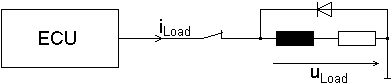
When simulating electrical errors in the wiring, the error potentials are switched by relays. In case an inductor is connected to your system, you must take precautionary measures to prevent the connected hardware from being damaged due to induced high voltage. You are recommended to use a freewheeling diode to avoid induced high voltage.
NOTICE
Overvoltage pulses in relays can cause electric arcs at the contacts of the relays. The electric arcs can weld the relays' contacts, which causes the contacts to be permanently short-circuited. A permanent short circuit can damage the hardware due to overheating.
Freewheeling diode
A freewheeling diode can avoid induced high voltage. It provides a discharge current path for the energy stored in a load. It allows the energy to dissipate slowly, rather than appearing as a voltage spike as it dissipates instantaneously. The following illustration shows an inductive load with a connected freewheeling diode.