Connecting a LabBox Using a DS6001 Processor Board
Introduction
Equipped with a DS6001 Processor Board and I/O boards, a SCALEXIO LabBox can constitute a compact stand-alone SCALEXIO system, a root in a distributed SCALEXIO system, or be part of a multiprocessor SCALEXIO system. A DS6001 Processor Board is also required to operate dSPACE Ethernet boards or CompactPCI® Serial boards in the extended I/O slots of a SCALEXIO LabBox.
SCALEXIO LabBox is connected to the host PC or network via the Host PC Ethernet (RJ45) connector on the front of the DS6001 Processor Board. Refer to Overview of the DS6001 Processor Board.
Network security
The SCALEXIO system offers interfaces for loading and executing real-time applications, for writing, reading, and measuring variables in the system's memory, and for transferring high-resolution time stamps to synchronize measurement data.
The interfaces do not offer authentication or encryption. The SCALEXIO system must therefore be used in a development network that is protected against external access. To ensure maximum security, preferably connect the SCALEXIO system to a host PC via a peer-to-peer connection. When you are using a multiprocessor system, set up a separate subnet that is only connected to the SCALEXIO systems involved and the related host PCs. By using a peer-to-peer connection or a separate subnet, the real-time requirements of the systems, for example, deterministic bandwidths, are guaranteed and possible external attack vectors on the SCALEXIO system are minimized.
Tutorial video
This video shows you how to install a DS6001 Processor Board into a SCALEXIO LabBox.
Stand-alone system
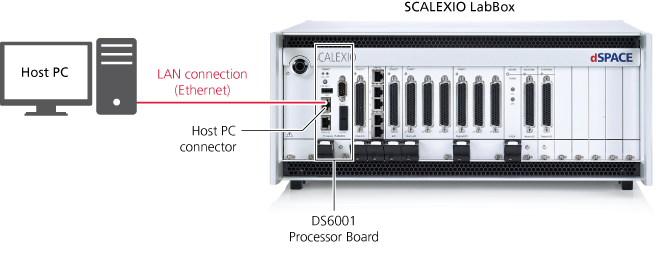
The following illustration shows a SCALEXIO LabBox (19‑slot) use as a stand-alone SCALEXIO system.
Node in a distributed system
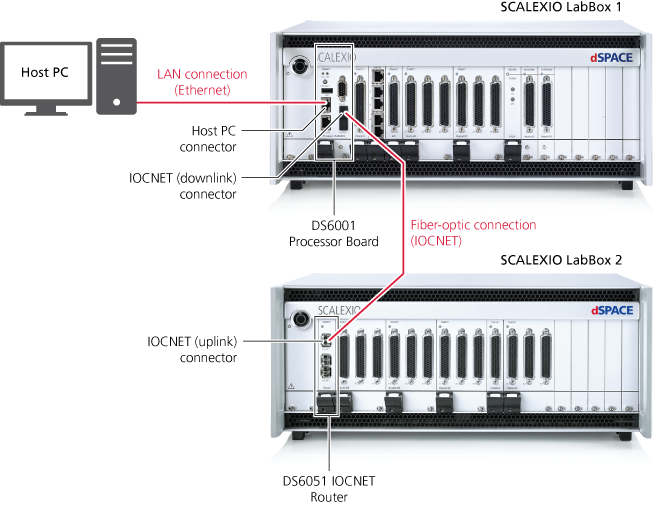
The following illustration shows a SCALEXIO LabBox (19‑slot) used as a node in a distributed system.
Multiprocessor system
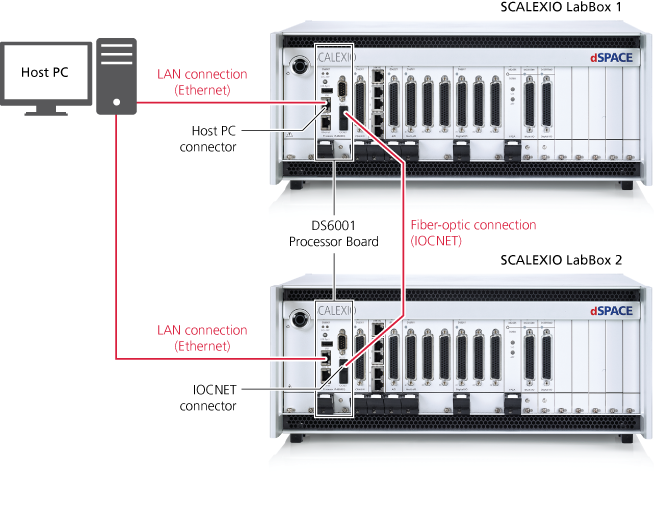
The following illustration shows a multiprocessor system with two SCALEXIO LabBoxes.