Modeling Executable Applications and Tasks
Objective
ConfigurationDesk lets you model executable applications (real-time applications) and the tasks used in them very flexibly to match your requirements.
Composition of an executable application
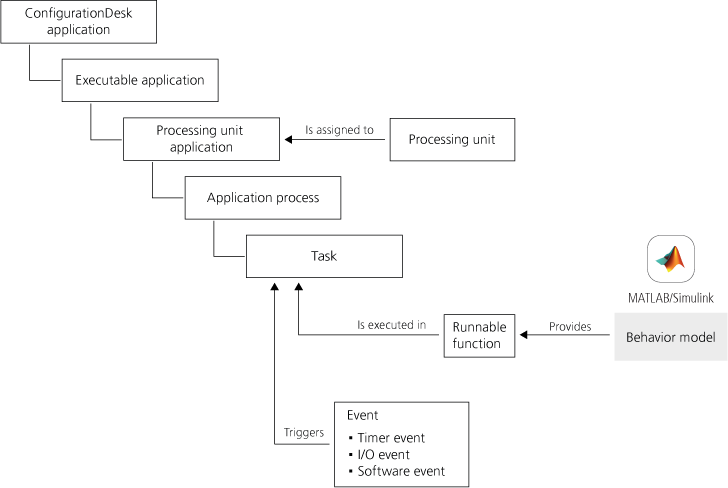
Each executable application consists of at least one processing unit application as its basic structural element. It contains at least one application process and at least one task. You can define the elements of a processing unit application, the application process, and the priorities of the tasks in the process.
The following illustration shows the elements of an executable application and their relationships:
- Task
An application process must have one or more tasks. You can assign a component which contains a predefined task (including its runnable functions and events) to an application process. Additionally, ConfigurationDesk lets you create new periodic or asynchronous tasks to execute runnable functions. The execution of tasks is triggered by timer events, I/O events, or software events.
- Timer event
You can create timer events in ConfigurationDesk, configure them (for example, their time periods) and assign them to a task to trigger it periodically.
- I/O event
Some function blocks provide event generation. When they are added to the signal chain, they can generate I/O events. You can use I/O events in an executable application by assigning them to a task to trigger it.
- Software event
Software events are specified in the behavior model. They are available in ConfigurationDesk after model analysis.
- Runnable function
Runnable functions are functions that are called by a task to compute results. A runnable function can be executed in a periodic or asynchronous task. A Simulink behavior model provides runnable functions for the following elements:
For the Simulink base rate task (no predefined task)
For each Runnable Function block in the Simulink model. This block exports a function-call subsystem as a runnable function. Thus, a runnable function groups together all the behavior model parts that must be called to compute results in a specific task. A Runnable Function block can provide a runnable function without predefined task or a predefined task including a runnable function.
You can access runnable functions after model analysis. Then you can assign the function to a task (periodic or asynchronous).